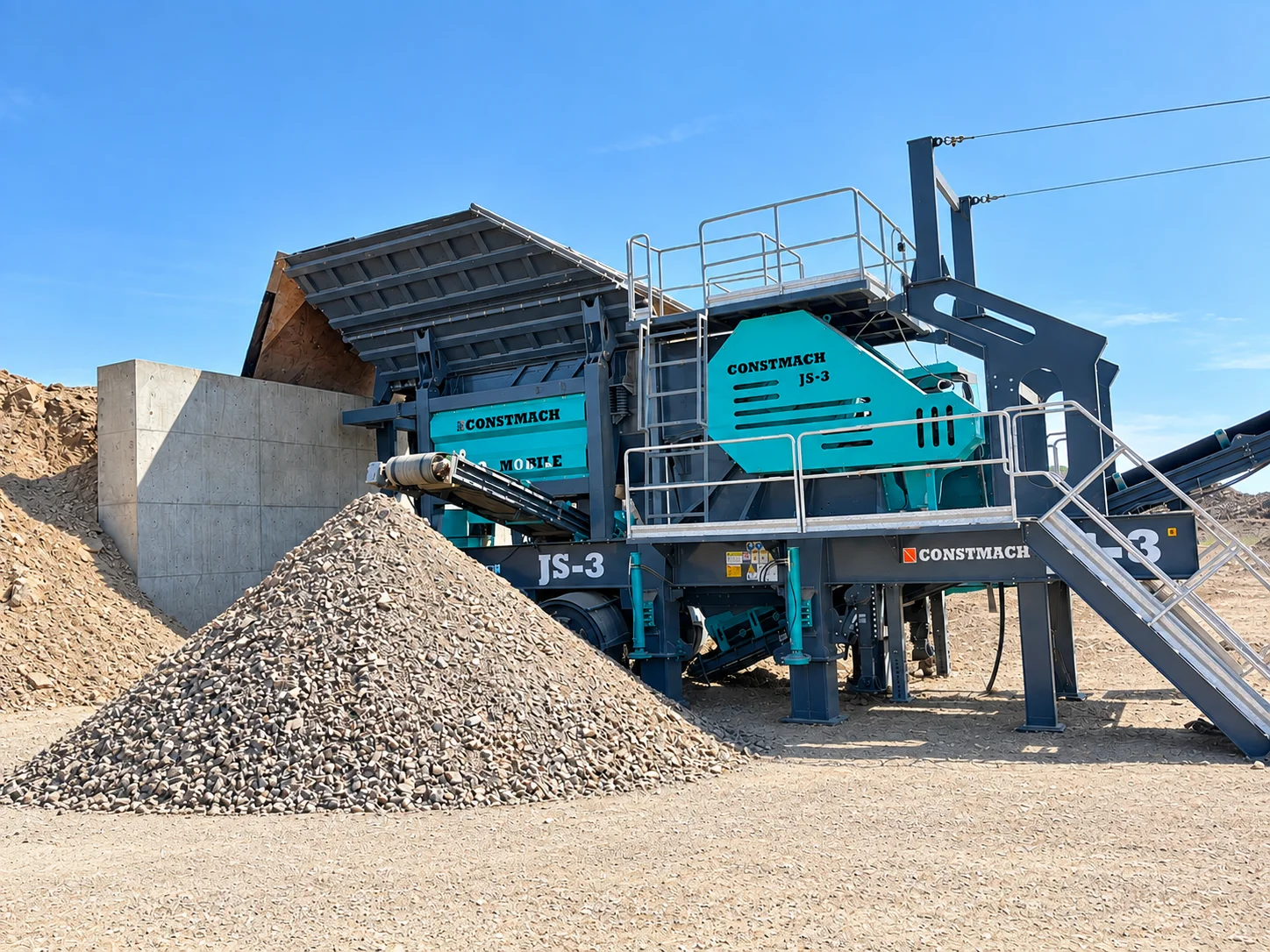
A mobile recycling plant is a crushing plant built to turn construction and demolition waste back into usable aggregate, mounted on a single wheeled chassis so it can be taken to the rubble instead of the rubble being taken to it. Constmach builds three models, the J Series, with capacities from 60 up to 250 tons per hour. Each one combines a feeding hopper, grizzly feeder, primary jaw crusher, by-pass conveyor and stockpile conveyor on one frame, together with a dust removing system, PLC automation and an optional magnet separator for pulling reinforcement steel out of the product.
What a Mobile Recycling Plant Is
A mobile recycling plant is not a single machine but a short crushing line assembled on one chassis. Demolition rubble is tipped into the hopper, metered forward by the grizzly feeder, reduced in the jaw crusher and carried out to a stockpile by conveyor. Soil and fine material leave the flow through a separate by-pass conveyor before they ever reach the crusher. Because every part of that line is already mounted, wired and plumbed on the frame, the plant arrives as one transport load and is working within hours rather than weeks.
The word mobile is doing real work here. A stationary recycling line is erected on foundations and stays where it is built; a mobile plant stands on its own wheels and hydraulic legs, needs no concrete, and moves on to the next demolition site when the work is finished. For a contractor whose jobs move every few weeks or months, that difference decides whether the plant is usable at all.
How Recycling Crushing Differs From Quarry Crushing
Crushing demolition waste is not the same job as crushing quarried rock, and a plant designed only for quarry duty will disappoint on a demolition site. Quarry feed is consistent: the same rock, roughly the same size, with little else in it. Demolition feed is the opposite. It arrives mixed with soil, dust, brick, timber, plastic and reinforcement steel, the piece size varies from sand to slab, and the moisture content changes with the weather.
That is why the J Series is built around a jaw crusher rather than an impact crusher, and why the by-pass conveyor and the optional magnet separator exist. A jaw compresses concrete and lets exposed rebar pass through; an impact crusher's rotor tends to catch steel and wrap it. The by-pass conveyor deals with the soil and fines that come with every load of rubble. The magnet separator handles the steel that the jaw releases. Each of those features is a direct answer to something that is in demolition waste and is not in quarry rock.
The Constmach J Series Range
Three models cover the range, all on a single chassis and all with the same component set. They differ in jaw crusher size, feed opening and capacity:
J-1 is the entry model, built around the CJC-60 primary jaw crusher with a 600 × 380 mm feed opening and a capacity of 60–80 tph. It is the smallest and most manoeuvrable of the three, and the easiest to place on a confined urban site.
J-2 steps up to the CJC-90 jaw crusher with an 850 × 600 mm feed opening and 120–150 tph. Total motor power is 95 kW, the recommended generator is 250 kVA, and the plant weighs 35 tonnes at 11 × 3.2 × 4.5 metres with a 4.5 metre feeding height.
J-3 is the largest, with a 1,050 × 800 mm feed opening and up to 250 tph. Total motor power is 175 kW, the recommended generator is 450 kVA, and the plant weighs 55 tonnes at 13 × 3.4 × 4.5 metres with a 6.3 metre feeding height and a 20 m³ feeding hopper.
The choice between them is driven by two things only: the tonnage you need per day, and the size of the pieces coming off the demolition. Everything else on the three plants is common.
How the Plant Works, Stage by Stage
Material moves through a mobile recycling plant in a continuous flow:
- Feeding. An excavator or wheel loader tips demolition rubble into the feeding hopper, which holds enough material to keep the plant working between machine cycles.
- Metering and scalping. The grizzly feeder draws material forward at a steady rate. Its grizzly section lets soil and fine material drop through rather than passing them into the crusher needlessly.
- By-pass. The scalped fines are carried off on the by-pass conveyor to their own stockpile, keeping them out of the crushed product.
- Primary crushing. The jaw crusher reduces concrete, reinforced concrete, brick and masonry to the product size set by its closed-side setting.
- Metal removal. Where the optional magnet separator is fitted, it lifts freed reinforcement steel off the discharge stream.
- Stockpiling. The stockpile conveyor carries the finished recycled aggregate out to a pile sized for the plant's output.
The sequence matters: scalping before crushing is what makes the difference between a clean, saleable recycled aggregate and a pile of mixed rubble.
What You Can Feed a Mobile Recycling Plant
The J Series is designed for the common construction and demolition waste streams:
Concrete waste and concrete slabs
Reinforced concrete, including rebar-heavy structural elements
General demolition debris
Bricks, blockwork and masonry waste
Similar recyclable mineral construction materials
Two limits apply. First, the piece must fit the feed opening of the model you choose; oversized slabs and beams are broken down with an excavator-mounted breaker before feeding, which is routine on demolition work. Second, the plant crushes mineral material. Waste streams heavy in timber, plastic, insulation or plasterboard should be sorted out before they reach the hopper, because those fractions do not crush and they contaminate the product.
What the Plant Produces
The output is a single crushed recycled aggregate, with its size governed by the jaw crusher's closed-side setting. In practice that product goes into road sub-base, backfill, drainage layers, site levelling and, where local standards and testing allow, back into new concrete as recycled aggregate. Fitting the magnet separator is what moves the material from mixed rubble to a product a buyer will accept, because free rebar ends are the single most common reason a load of recycled aggregate gets rejected.
A mobile recycling plant produces one crushed fraction, not several graded ones. If your customers need multiple sizes separated to specification, the plant needs a screen behind it or the work belongs on a stationary crushing and screening line.
Removing Reinforcement Steel
Reinforcement steel is the defining problem of concrete recycling, and it is handled in two stages rather than one. The jaw crusher does the first part: compressive crushing breaks the concrete away from the bar and frees it, where an impact crusher's rotor would more often catch it. The magnet separator does the second part, mounted over the discharge conveyor to lift ferrous metal off the moving product.
The separator is listed as optional because not every operation needs it — a contractor crushing unreinforced brick and block does not. For anyone processing reinforced concrete it is the component that determines whether the output is sellable, and the recovered steel has its own scrap value that offsets part of the cost.
Soil and Fines: the By-pass Conveyor
Every load of demolition rubble arrives with soil, dust and small debris in it, and none of that fraction needs crushing. The by-pass conveyor takes it out of the flow ahead of the crusher, which does three useful things at once: the finished aggregate stays cleaner and better graded, the crusher's available capacity goes to material that actually needs reducing, and the jaw plates are not being worn down for nothing. The separated fines are stockpiled on their own and can frequently still be used as fill on the same site.
When a Mobile Recycling Plant Is the Wrong Choice
There are jobs these plants should not be bought for, and it is cheaper to know that before ordering than after.
If production stays on one site for years and the tonnage is high, a stationary crushing and screening plant will beat any mobile plant on cost per tonne, peak throughput and product range, because it can carry secondary crushing and multi-deck screening. If you need several graded fractions to specification, a single-stage mobile plant will not deliver them without additional screening equipment. If the feed is hard, abrasive quarried rock rather than demolition waste, the mobile hard stone and jaw-and-impact plants in the Mobile Crushing Plants range are engineered for that duty. And if the daily volume is genuinely small and occasional, hiring a contractor with a plant is usually sounder than buying one.
Capacity and Sizing
Size the plant on the tonnage you must process in a working day, not on the peak hour. Rated capacities of 60–80, 120–150 and 250 tph are figures for suitable feed at a given crusher setting; real output falls when the feed is wet, when the piece size is close to the feed opening, or when feeding is intermittent because only one excavator is serving the plant. A plant fed in bursts will not reach its rated figure no matter how it is specified.
Feed opening deserves as much attention as capacity. A plant that is big enough on paper but whose opening is too small for the material coming off the building will spend its day waiting for the breaker, and the effective capacity will be set by the excavator rather than the crusher.
Power Supply and Generators
Where a mains supply of adequate capacity exists on site, the plant runs from it directly. On demolition work that is often not the case, because the site supply is normally disconnected before demolition begins, so a generator is the usual answer. Generator ratings are specified well above total motor power — 250 kVA against 95 kW on J-2, 450 kVA against 175 kW on J-3 — because the crusher and feeder draw a starting current far above their running current, and the plant must absorb the load swing when a large piece of reinforced concrete enters the chamber. Undersizing the generator shows up as nuisance tripping under exactly the conditions you bought the plant for.
Transport, Site Setup and Permits
Each plant travels as a single unit on its own wheels rather than being dismantled into sections, which is the main practical advantage over erecting a line on site. The transport dimensions and weights matter for route planning: J-2 at 35 tonnes and 11 × 3.2 × 4.5 metres, J-3 at 55 tonnes and 13 × 3.4 × 4.5 metres. Both should be checked against axle-load limits, bridge heights and local abnormal-load permit rules before the delivery date is fixed.
On site, the requirement is a flat load-bearing pad, not a foundation. The plant is positioned, levelled on its hydraulic legs and connected to power. Leave room for the feed machine to work, and size the stockpile area for a full day's output so the plant is not stopped waiting for a loader to clear the pile.
Dust, Noise and Urban Site Management
Recycling plants work closer to people than quarry plants do, often inside cities on urban renewal sites, so dust and noise are planning conditions rather than afterthoughts. Every J Series plant includes a dust removing system that suppresses dust where it is generated, at the crusher discharge and the transfer points. It needs a water supply on site and a daily nozzle check, because demolition dust blocks nozzles faster than quarry dust does.
Beyond the equipment, the usual measures apply: keep the drop height on the stockpile conveyor low, damp down haul routes in dry weather, screen the stockpile area where neighbours are close, and schedule crushing within the hours your permit allows.
Wear Parts and Daily Checks
Recycled concrete is more abrasive than most people expect, and the rebar ends in it shorten wear-part life compared with clean quarried stone. Attention concentrates on the jaw plates, the grizzly bars, the feeder liners and the conveyor belts. Jaw plates are bolted and reversible, so they are turned once before being replaced, and keeping a spare set on site is what prevents a plate change from costing a day's production.
Daily checks cover the dust system's water supply and nozzles, belt tracking and condition, the hydraulic circuit for the legs, and greasing to the schedule in the manual. Constmach supplies a recommended spare-part list with the plant, matched to expected operating hours.
Automation and Operator Control
All three models are supplied with a fully automatic control system operated from a tablet controller, so one person can run the plant from where they can actually see the feed and the stockpile. The control panel is built around a PLC with EATON – Germany electrical and electronic components, with all the necessary wiring included, and it is housed in a double-layer panel-in-panel enclosure that keeps dust and rain off the electronics. On a demolition site that enclosure earns its place: dust ingress into control gear is a far more common cause of downtime than any mechanical failure.
How to Choose Between J-1, J-2 and J-3
Work through four questions in order. What is the largest piece you will realistically feed, before breaking? That sets the minimum feed opening and often decides the model on its own. What tonnage must you process per working day, allowing for the fact that a plant fed by one excavator rarely holds its rated figure? That sets the capacity class. How often will the plant move, and what are the weight and height limits on your routes? A 55 tonne plant is a different transport proposition from a 35 tonne one. And will you be processing reinforced concrete? If so, specify the magnet separator at order rather than retrofitting it later.
If the answers point between two models, the larger one is usually the safer choice, because capacity lost to wet feed and intermittent loading is real and permanent, while surplus capacity only costs money once. Constmach engineers each plant around the project and can advise on the configuration against your own feed material and output requirement.